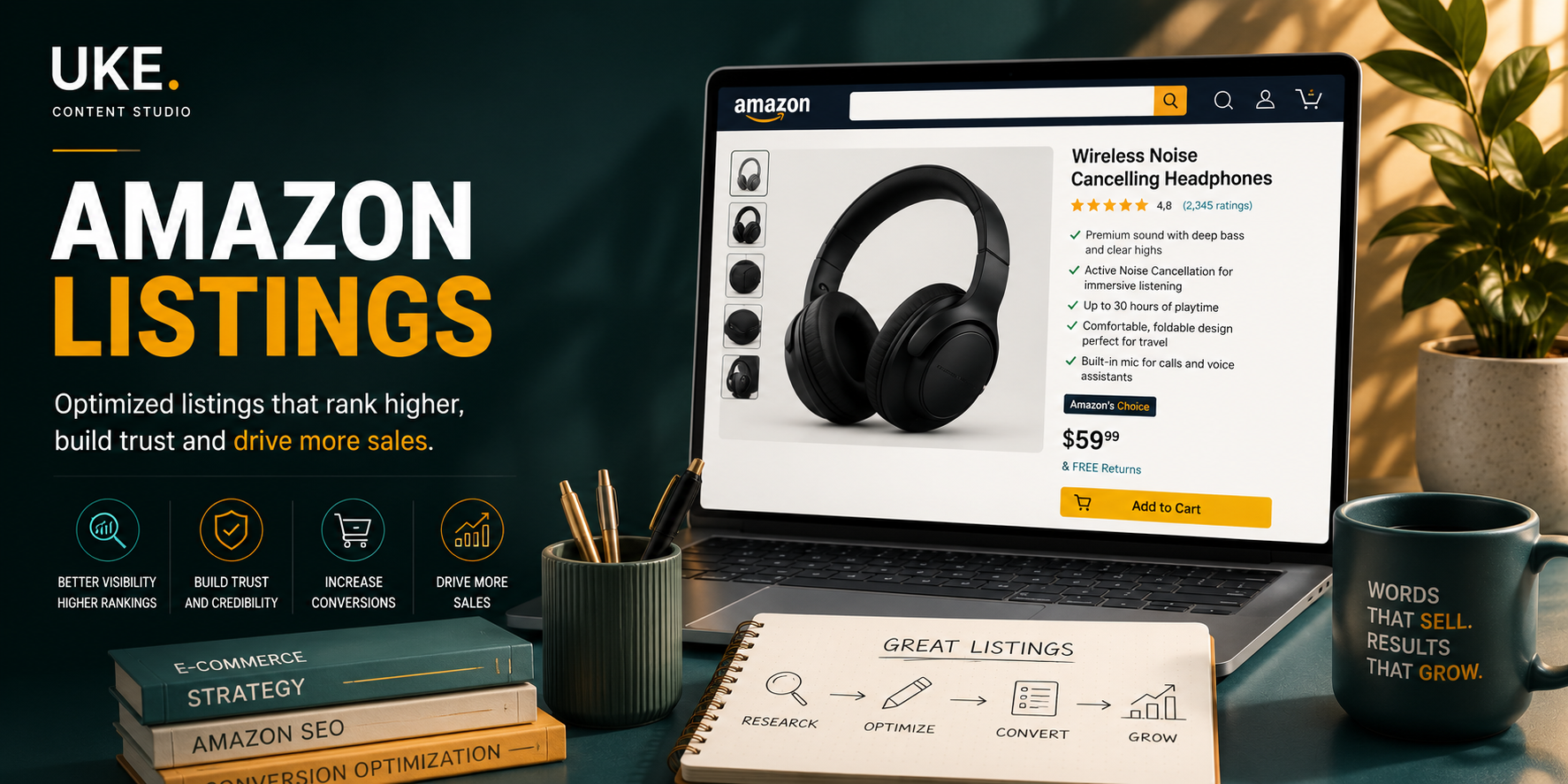
An Amazon listing works inside a competitive environment. Customers compare products quickly, often using only the title, main image, price, ratings and first bullet points before deciding whether to continue.
The listing therefore needs to communicate relevance immediately while providing enough detail to support a confident purchase.
What a strong Amazon listing must achieve
Every section of the listing should support one of three goals: discovery, understanding or conversion.
- Discovery: Help the product appear for relevant searches.
- Understanding: Make the product, audience and use clear.
- Conversion: Reduce doubt and present a convincing reason to buy.
Problems arise when one goal dominates the others. A keyword-heavy listing may gain visibility but lose readability. A beautifully written description may sound persuasive but fail to match the searches customers use.

Build a title that is informative before it is impressive
The title should help customers identify the product quickly. It must include important search language without becoming difficult to read.
Lead with the essential product identity
State what the product is before adding secondary specifications. Customers should not need to decode the title.
Include meaningful differentiators
Size, material, compatibility, quantity, audience or primary use may belong in the title when they affect the buying decision.
Avoid repetition
Repeating the same keyword in several forms wastes space and makes the title feel manufactured.
Keep the title readable
Keyword inclusion should follow a natural order. A title that looks like a search query may reduce trust even when it contains relevant terms.
The title earns relevance. The rest of the listing must turn that relevance into confidence.
Use bullet points to connect features with customer benefits
Bullet points are among the most visible content elements on an Amazon page. They should answer important questions and communicate the value of the product without requiring the customer to read the full description.
Start each bullet with a clear benefit
Lead with the practical outcome, then explain the feature that makes it possible.
Give each bullet one purpose
Avoid combining several unrelated ideas inside one long paragraph. Clear separation improves scanning.
Anticipate purchase objections
Use bullets to clarify durability, compatibility, comfort, maintenance, package contents or other factors that may create hesitation.
Use specific language
Replace broad claims with materials, measurements, design details and realistic use cases.
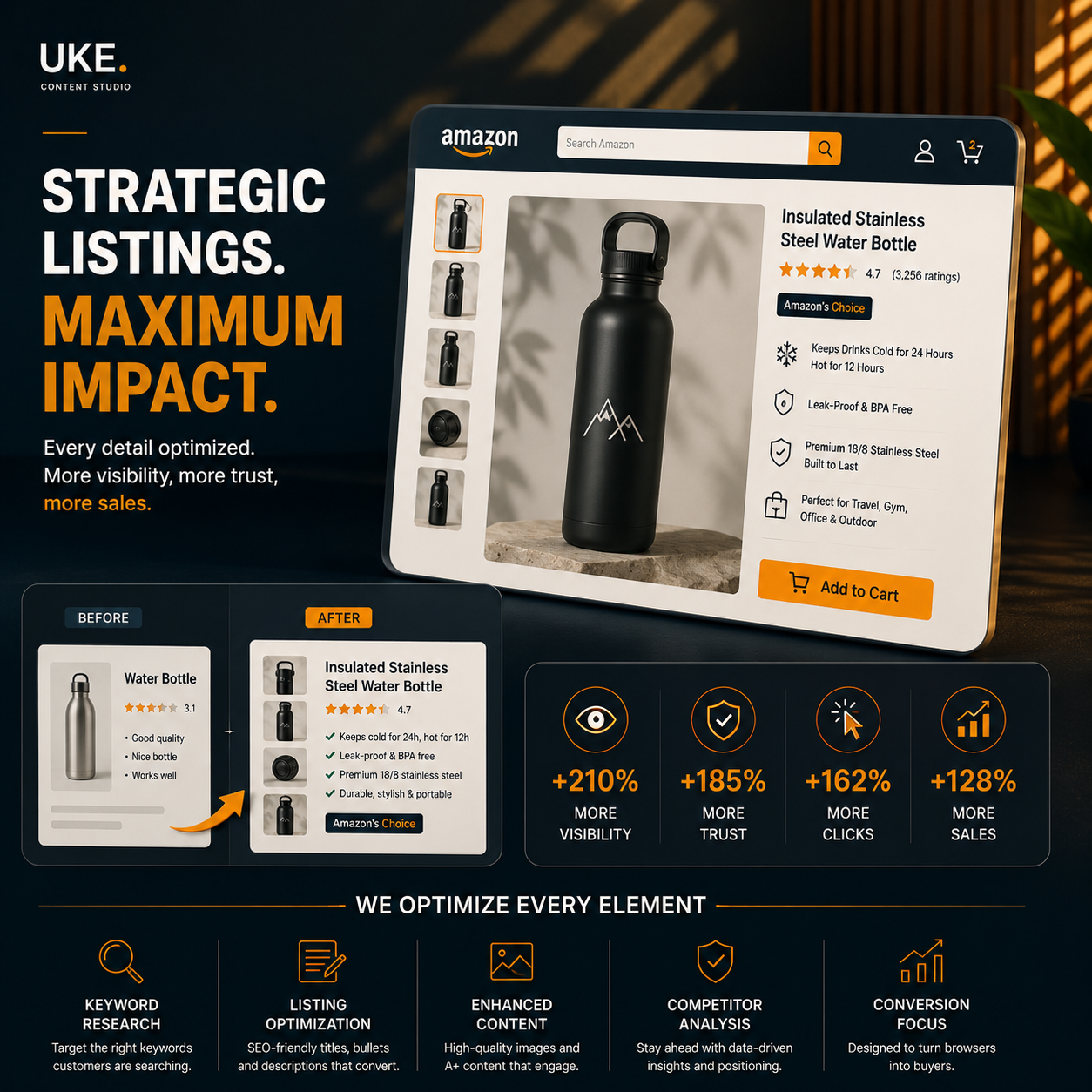
Balance keyword relevance with natural readability
Search terms are essential, but every keyword does not need to appear everywhere. The goal is coverage without unnecessary repetition.
Use keyword research to identify:
- The primary product category and exact product type.
- Important attributes customers search for.
- Use cases, audiences and compatibility terms.
- Natural variations and related phrases.
- Terms that belong in backend search fields rather than visible copy.
Prioritize customer comprehension in visible content. A phrase that harms readability may be better placed in backend fields if it is still relevant.
Build trust and make the product easier to compare
Customers often compare several similar products. The listing should make meaningful differences easy to understand.
Explain what is genuinely different
Focus on design, materials, performance, convenience or included value rather than generic claims such as “best quality.”
Maintain consistency across the page
The title, bullets, images, A+ content and specifications should support the same message. Contradictions create doubt.
Use images to confirm written claims
Lifestyle images, dimensions, comparison graphics and feature callouts should reinforce the copy rather than introduce unrelated promises.
Do not hide limitations
Clear compatibility and usage conditions reduce returns and help the right customer choose the product.
Final Amazon listing quality checklist
Product identity
Is the product immediately clear from the title?
Keyword coverage
Are relevant terms included without forced repetition?
Bullet quality
Does each bullet communicate one clear benefit?
Decision details
Are size, material, compatibility and contents easy to find?
Differentiation
Does the listing explain why this product is meaningfully different?
Consistency
Do the copy, images and specifications support the same message?
Competitive Amazon listings make products easier to find, understand and trust. Optimization works best when search strategy and customer communication are treated as one process.